
BLOG
Japanese Dragon Back Piece by TomTom
A full-back Japanese tattoo is one of the most visually powerful and culturally significant forms of body art. Among the most popular motifs is the dragon — a symbol of strength, protection, and wisdom — this one is paired with sakura (cherry blossoms), which contrast the dragon’s energy with themes of impermanence and beauty.
A typical full-back Japanese dragon tattoo often features the dragon’s body coiled across the entire back, with the face positioned centrally along the spine. This central placement draws immediate attention and creates symmetry, anchoring the design. The dragon is usually depicted in traditional Japanese style — elongated, serpentine, and dynamic — with intricate scales, claws, and a fierce expression.
Behind or around the dragon, sakura petals or full blossoms are integrated into the background. The blossoms are often scattered across the design, giving the impression of wind or motion, adding visual depth and balance to the more aggressive energy of the dragon.
In Japanese culture, dragons are associated with water, storms, and natural forces. Unlike in Western mythology, they are typically protectors and are seen as wise and noble creatures. A dragon tattoo represents strength, control, and spiritual awareness.
Placing the dragon’s face in the middle of the back, especially along the spine, serves both an aesthetic and symbolic purpose. It creates a visual focal point and reinforces ideas of vigilance and protection. The eyes looking outward convey power and presence.
Sakura symbolise the fleeting nature of life. They bloom briefly and fall quickly, reminding people of the temporary nature of beauty and existence. Including sakura in the tattoo adds contrast to the dragon’s permanence, creating a dual message of strength and awareness of life’s transience.
This type of tattoo is typically done in the irezumi style — traditional Japanese tattooing, characterised by bold outlines, detailed shading, and strong colour work. Common colour schemes include black, gray, and dark green for the dragon, with red, pink, and white for the sakura. Backgrounds may include clouds, wind bars, or waves, enhancing the motion and flow of the design.
Due to the scale and detail, this kind of tattoo often requires multiple sessions and a high pain tolerance. It’s a serious commitment and typically chosen by individuals with a deep respect for the cultural and symbolic elements.

WELCOME BACK CARPE
We’re so excited to have our good mate Carpe back with us at Sunset after some time overseas!
Carpe’s been off gathering inspiration and honing his craft, and now he’s back with fresh ideas and that same steady hand we all know and love. He specialises in Japanese tattooing and fine line work—whether it’s a big, bold dragon or a super clean, minimal piece, he nails it every time.
His Japanese work really captures the flow and tradition of the style, and his fine line stuff is insanely precise. If you’ve been thinking about getting something done, now’s the perfect time—Carpe’s back, his books are open, and we’re stoked to have him in the studio again.


Double Koi Sleeve by Horiyama
In Japanese culture, the koi fish is a symbol of strength, determination, and transformation. According to legend, koi that swim upstream and ascend waterfalls are rewarded by being transformed into dragons—a metaphor for perseverance through adversity. When paired, two koi often represent duality: balance between opposing forces, such as yin and yang, or the interconnected dance between masculine and feminine energies.
Each koi’s colour can also carry its own meaning. A black koi symbolises overcoming struggles, a red one represents passionate love or strength, and gold signifies prosperity and wealth. Whether placed in opposing directions or swimming in a circular flow, two koi suggest harmony in movement and a never-ending pursuit of growth.
Ginkgo biloba, one of the oldest tree species on Earth, is a revered symbol in Japanese art and philosophy. Its fan-shaped leaves represent endurance, timeless beauty, and peaceful strength. Ginkgo trees famously survived the Hiroshima bombing, further embedding them in the national consciousness as emblems of resilience and hope.
In tattoo art, ginkgo leaves bring an organic softness that contrasts with the dynamic motion of koi. Their flowing forms complement the sleeve’s curves, gently framing the koi and adding balance to the composition.


Watanabe no Tsuna and the Ibaraki Demon by TomTom
Among the many motifs in traditional Japanese tattooing (irezumi), the battle between Watanabe no Tsuna and the Ibaraki Demon stands out as a design that combines visual intensity with rich cultural meaning.
The story comes from Heian-era folklore. Watanabe no Tsuna, a loyal retainer of Minamoto no Yorimitsu, was sent to investigate strange happenings at the Rashōmon gate in Kyoto. There, he confronted a fearsome oni—Ibaraki-dōji. In a swift and violent clash, Tsuna managed to sever the demon’s arm. He brought it home as a trophy, but days later, the demon returned in disguise, stole the arm back, and vanished.
This scene has been portrayed in Japanese art for centuries, and in tattooing, it becomes a dynamic narrative across the skin. Beyond the visual drama, the design holds symbolic weight. Tsuna represents bravery, loyalty, and discipline in the face of chaos. The demon stands for deception, inner struggle, or lingering threats. Together, they create a powerful metaphor for personal battles—those moments in life where we’re tested by forces beyond our control, and where even victory may leave something unfinished.


Snake and Sakura Sleeve by Horiyama
In Japanese tattoo culture, the snake—or "hebi"—carries a complex symbolism. Far from simply representing something sinister, the Japanese snake is a multi-faceted creature. It’s a guardian of treasure, a protector from bad luck, and a symbol of healing and regeneration. Much like a snake sheds its skin, it also represents transformation and personal growth.
Depending on the design, the snake can be coiled in a defensive posture, slithering upward in pursuit of a goal, or wrapped protectively around other elements in the tattoo. It can appear fierce, wise, or serene—all depending on the story the wearer wants to tell.
Cherry blossoms, or sakura, are deeply embedded in Japanese art and philosophy. These delicate flowers bloom in a burst of beauty for only a short time each spring, serving as a poignant reminder of the fleeting nature of life. They represent impermanence—"mono no aware"—a bittersweet awareness of life’s transience and the appreciation of its passing beauty.
In tattoo art, sakura often accompany more dominant elements, offering a gentle, poetic counterbalance. When paired with something as intense as a snake, they soften the imagery, suggesting harmony between life’s harsh realities and its fleeting joys.
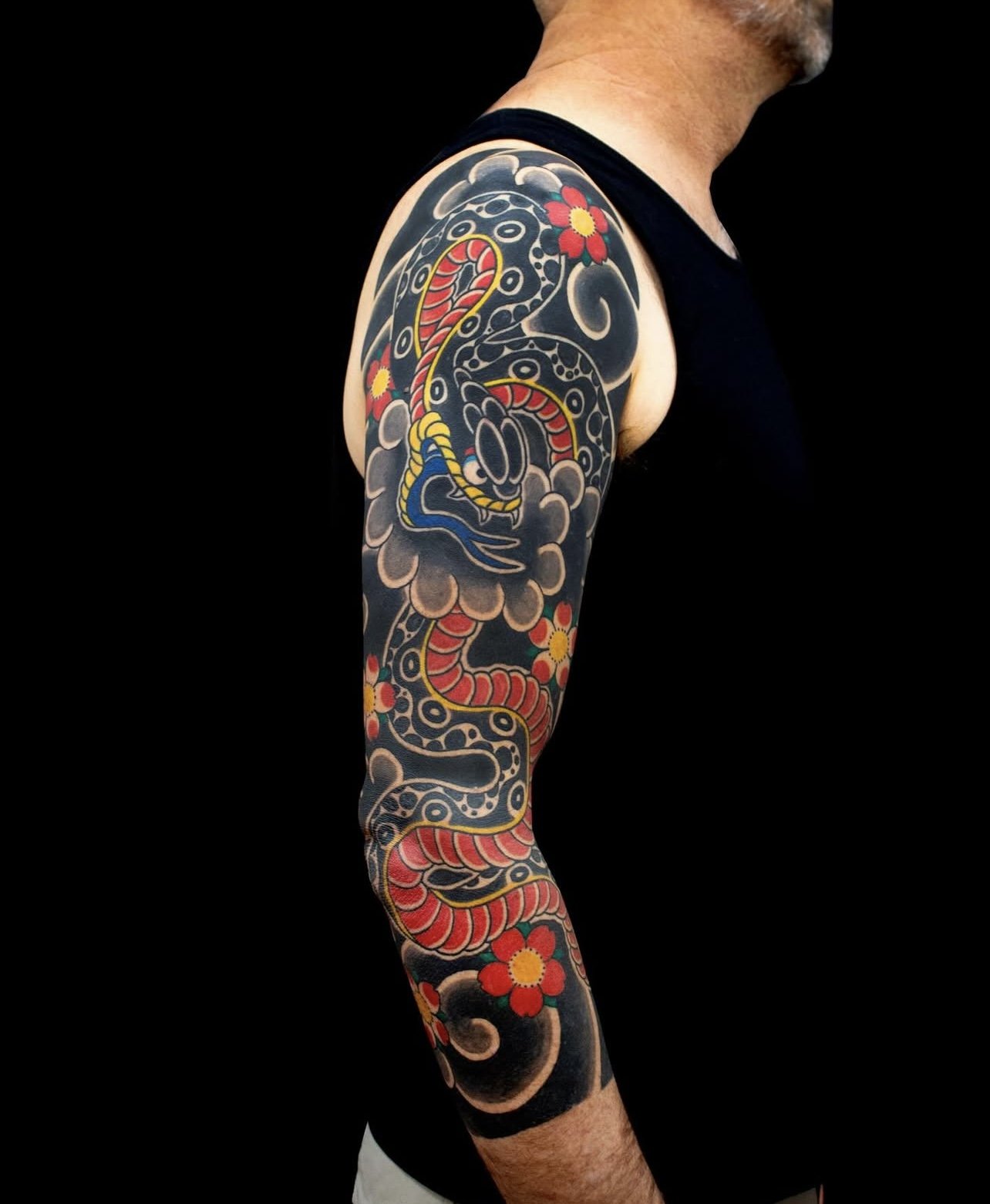

A Japanese arm sleeve tattoo that combines a snake and sakura is a stunning blend of opposing yet complementary energies. The snake’s coiling, sinuous form makes it perfect for wrapping around the curves of the arm, creating movement and depth. The cherry blossoms, whether floating freely or clinging to branches, provide bursts of colour and symbolism throughout the piece.