BLOG
We will be open to clients at Covid-19 Alert Level 2!
Sunset Tattoo is extremely stoked to announce that we will be reopening our studio to clients at Covid-19 (Coronavirus) Alert Level 2.
Our artists have been putting in huge efforts drawing, painting and creating new flash and tattoo concepts from home during lockdown, so expect to see lots of epic new tattoos to come out of our central Auckland studio. There’s also been a huge effort put in at the studio to revamp the place and during Level 3 in preparation for reopening. It’s looking so fresh and so clean - we can’t wait for all our clients to see how stunning the space looks!

Koi and Kintaro tattoo concept by Horimatsu Bunshin!
Although the spruce up has been super fun, what we love doing most of all is tattooing! We have been following the news meticulously, and have created Alert Level 2 rules to make sure our staff, clients and artists are all kept safe. The government has provided New Zealand with fantastic guidelines, and we’re stepping up our already excellent hygiene levels to include more PPE (Personal Protective Equipment) and extra spot cleaning of high touch and high traffic areas of the studio.
At Sunset Tattoo, we specialise in Japanese, Maori, Black work and Western Traditional Tattooing. Home to Auckland’s best tattoo artists, we have a gorgeous space on Cross Street, located just behind Auckland’s iconic Karangahape Road (K Road). To create a tattoo appointment, please contact the studio for all booking requests and enquiries.
CONTACT:
www.sunsettattoo.co.nz
info@sunsettattoo.co.nz
(+649)3763423
Get to know your Yokai! Tsukumogami: forgotten objects which spring to life on their 100th birthday!
Another instalment of “Get to know your Yokai!”. Yokai are monsters, spirits, phantoms, ghosts, demons and other various supernatural beings from Japanese folklore. They’re super interesting, make for great stories with their quirky attributes and like many fairytales, important life lessons those who study them can away and apply to their lives. Yokai are celebrated through many artistic mediums, such as paintings, film and you guessed it, epic tattoos!

Various Tsukumogami.
Tsukumogami are a class of Yokai, in which formerly inanimate objects upon their 100th birthday spring to life and acquire a spirit. They are generally long forgotten, unused household items, but can also inhabit long abandoned houses as well. Tsukumogami are *generally* not evil or dangerous spirits like many Yokai, they’re more pranksters who want to remind you that they once had a use, and you shouldn’t have tossed them aside, so they’re going to play tricks on you as their form of haunting. It’s thought that the idea of Tsukuogami has it’s roots in the union of Shintoism and Buddhism, which led to the belief that everything has a soul, whether it be an animal, a person or just a plain household object.

Karakasa Kozo by Capilli Tupou.
A much loved Tsukumogami is the Karakasa Kozo, sometimes referred to as the kasa obake, or karakasa obake. This roughly translates to “umbrella ghost” or adorably, “paper umbrella priest boy”. These oddly darling Yokai are usually represented as Wagasa (oil-paper umbrellas) metamorphosed into animated creatures with an incredibly long tongue, a single bulbous eye, and one leg upon which they hop about recklessly. The favourite prank of the Karakasa Kozo is to sneak up on it’s victim when they’re least expecting it, and proceed to give them a huge slimy lick with their gigantic tongue. As far as hauntings go, this is pretty tame, however quite hideous none the less.

Karakasa Kozo by Horimatsu Bunshin.

Bakezori by Milky.
Another mischievous Yokai is a long forgotten and slightly OCD sandal, who is sick and tired of being mistreated and ignored so has come to life to steal your socks and play tricks on you in hopes of you taking better care of your foot ware. He is called the Bakezori! A traditional Japanese sandal (a “Zori”) made out of woven rice straw, when he becomes a Yokai on his 100th birthday. He has little arms and legs, one big eye and a long protruding tongue. Much like the Karakasa Kozo, he isn’t usually considered dangerous, and haunts by way of playing tricks. If you have ever walked down your hall way at night and swear you have heard someone walking behind you, only to turn around and there be no one, that’s when you know you have a Bakezori in your house.
Generally motivated by both boredom and frustration at being discarded by their owners that they served so faithfully, or jealousy and revenge towards other, newer items (particuly Geta, the Zori’s wooden, more noble cousin) they love to pester humans, and often team up with other Tsukumogami to do this. They’re known to be organised, and will rearrange your shoes you so carelessly kicked off at the entrance of your house, and organise the shoes in your cupboard from small to large. If you’ve ever made the assumption that you have a “sock monster” in your house, you may in fact have a Bakezori. Super jealous of socks (they prefer the skin to sandal contact of a foot directly on them), they can often be to blame for your missing or worn out socks. Continued neglect of these sensitive beings will lead them to feel incredibly left out, and they will simply run away and find a new place to live.

The sensitive Bakezori just wants skin to skin contact.
One final Tsukumogami Yokai is the Chochin Obake, also known as bake-chochin, chochin kozo, or simply Chochin, or in English “the paper lantern ghost”. The legend of the Chochin Obkae is thought to have been the sight of paper lanterns (which were once seen everywhere to light outside of houses, shops roads and alleyways) flickering and flailing about and moaning in the wind, making them seem alive. This, and the idea that upon their 100th birthday, inanimate objects come alive. The appearance of Chochin Obake has similarities to both the Karakasa Kozo and the Bakezori, in which it has a long, lolling tongue hanging out of it’s split paper mouth, and one or two big eyes. Sometimes they are shown as having arms and/or legs, but this is less frequent as the Chochin Obake usually either floats or is hanging up.

Chochin Obake by Horimatsu Bunshin.

Chochin Obake by Milky.
Like the Karakasa Kozo and the Bakezori, it’s main schtick is to frighten people by ay of surprise. He has a particular fondness to cackling while rolling his bulbous eyes and long tongue around at guests you have in your household, as well as watch and glare at your as you are going about your day. Occasionally Onryo, one of the most powerful, destructive and dangerous supernatural beings takes possession of a paper lantern and imitates a Chochin Obake. A famous Onryo is seen in modern pop culture is the long haired ghostly woman in horror films The Grudge and The Ring. When this happens, it’s super dangerous as the Onryo is a violent spirit whose only mission is to cause destruction, and the harmless Chochin Obake just wants to give a little fright to those who may have forgotten him. It pays to be wary around any haunted lanterns, in case a more sinister demon is present.

Karakasa Kozo by Horimatsu Bunshin
Traditional folklore stories that involve Tsukumogami, along with many other Yokai, make for great moralistic stories. They remind people that you don’t need to have too many material possessions, and we shouldn’t forget about items that served us well. In the modern era, a time of rabid consumerism and throw away culture many of us have been brought up in, these tales are a good reminder to “buy once, buy well”, to slow our lives down, to learn to fix things instead of dispose and replace. Fast fashion, bad quality and bad craftsmanship is a byproduct of our incessant need to consume and upgrade, that perhaps a little haunting from our long forgotten items that are still useful is what we need to learn to ease up on our negative impact on our planet. If my perfectly good ukulele I bought a couple years back decided to start playing itself and licking my face in the middle of the night, maybe I’d be slightly more inclined to play it, or the bicycle that’s gathering dust in the hallway zoomed madly around the house maybe I would remember to ride it. Maybe as a people, if we viewed all the items in our lives as possessing some form of soul, we would so hastily upgrade to the newest, shinier model, throw away or forget about items that served us so faithfully during its time in our lives.
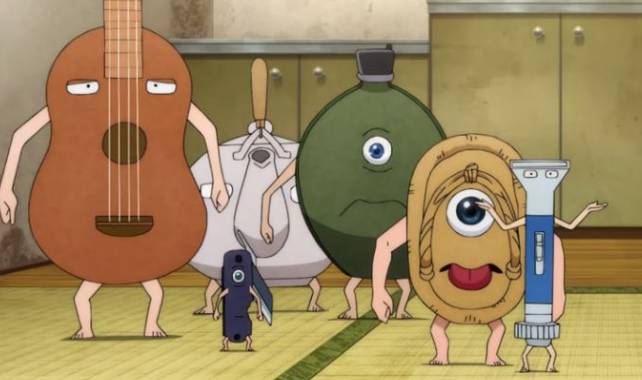
Tsukumogami from Japanese anime gegege no kitaro. Fully useful household items who are tired of being forgotten, Tsukumogami spring to life after long periods of abandonment, or on their 100th birthday.
Sunset Tattoo is the home of Japanese tattooing in Auckland, New Zealand. We have a handful of Auckland’s best artists who are utterly obsessed with this style, and have made it the mission of their careers to master this traditional, world renowned tattoo form. Smaller one shot, or larger Irezumi pieces are both welcomed by our talented artists. From Uber-traditional Tebori tattooing, to western traditional/Japanese fusion we have an artist to suit each and every unique Japanese tattoo request. For more information, please get in touch with the studio.
CONTACT:
www.sunsettattoo.co.nz
info@sunsetattoo.co.nz
Skull tattoos - a cult classic!
“A sacred symbol of luck or intellect, protection or fear, flesh or the soul, death or resurrection, divinity or the devil, it’s mystical and spiritual powers have captivated humanity and cast the skull as an emblem for the human consciousness, a memento mori through which to explore the transience of life, death and the human soul” - The Book of Skulls, by Faye Dowling.
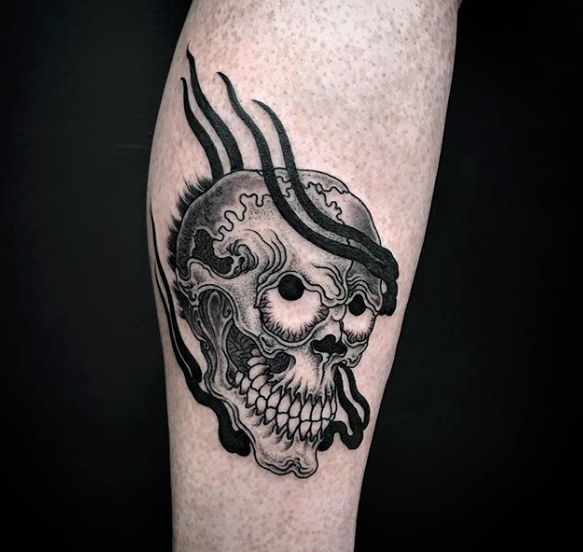
By Roger Moore.
Skulls have long been a fascination for the human psyche. Morbid lot, aren’t we? This fascination may come across as being obsessed with death, which is fair, however there is more to the symbolism of skulls than just death and decay. Going back thousands of years, we have seen skulls heavily depicted in mythology, religion, literature, architecture, art and fashion. When you think about it, perhaps the skull is the most iconic and recognisable symbol humanity - when all else is stripped away, a skull is the one feature that shows that we are human beings.

By Lucky Felix.
In more modern times, skulls are synonymous with the counter culture. Rock n’ rollers, punks, skaters, motor cycle gangs and goths are all known to adorn themselves with skulls, whether thats through a tattoo, a patch, a band t shirt or artwork, skulls are definitely prevalent within these sub cultures of society.

By Bernard Kwok.
Even though the sight of a pink haired kid wearing a Misfits t-shirt might unsettle your nana, history would argue that the skull has not exclusively been used to invoke thoughts of intimidation, fear or rebellion. Perhaps it’s quite the opposite. Skulls, worn as jewellery by Gods in many Eastern religions, serve as a reminder of the frailty of life. Mortals, unlike their Godly counterparts have no ownership over this. A subtle token that we have one life, and we should use it now, as in one fleeting moment it could all be undone. That’s a pretty positive message!

By Milky.
Skulls will always be a revered, thought provoking tattoo. It doesn’t matter if you get a skull because you’re into the idea aesthetically, or you want to carry a visual memento around with you forever, seeing as we can trace skulls in ancient arts over 5000 years ago, I think we can safely say they’re more than a logo for a rebellious teen. A timeless classic subject that fluidly transcends all styles of tattooing, you can never go wrong with one of the most recognisable symbols of all time, the humble human skull.

By Roger Moore.
Sunset Tattoo studio is located in central Auckland, New Zealand, and is home to some of the countries best tattoo artists. We specialise in Japanese, Maori, western traditional and black work tattoos. For requests, bookings and more information regarding our stellar artists, please contact the studio.
CONTACT:
www.sunsettattoo.co.nz
info@sunsettattoo.co.nz
(+649)3763423
Maori flora and fauna tattoos
Our resident Ta Moko (traditional Maori tattoo) artist Manawa Tapu has enjoyed having time to paint during the government ordered Covid-19/Coronavirus lockdown.
As well as being an incredible tattooist, he is also a phenomenal painter, and also wood carver. It’s really cool to see the different skill sets tattoo artists have when using other mediums than skin!

Close up of “Prey for Eyes” by Manawa Tapu.
Manawa Tapu has been painting a bunch of New Zealand/Aotearoa flora and fauna, which is quite different to what we usually see from him. One of our favourite pieces is this Pāpaka (crab), which as well as being a wicked painting is available to be tattooed. Manawa Tapu would love to tattoo more native New Zealand/Aotearoa species - what would you like to see done in this style?

Pāpaka by Manawa Tapu.
New Zealand is home to incredible bird, insect and aquatic life. Due to our little nation splitting away and becoming a stand alone set of islands over 50 million years ago, our species evolved some interesting quirks. Birds becoming flightless was one of the most interesting traits, as birds had no dangerous mammalian predators. In fact, the only land mammals native to New Zealand are two types of small fruit bat.
Manawa Tapu’s “Prey For Eyes” shows a Battle Royale between the extinct Haast Eagle and Moa. The Haast eagle was the most impressive eagle the world has ever seen, with a wingspan of 3 meters and claws as strong as a tigers. The Giant Moa were flightless birds that stood around 2 meters in height, and seemed to be vegetarians. These epic birds are just two examples of New Zealand’s incredible avian creatures.

“Prey For Eyes” by Manawa Tapu.
If you’re interested in showing your love for New Zealand’s gorgeous native flora and fauna, represented with beautiful Maori pattern work by the one and only Manawa Tapu, please get in touch with the studio to discuss your ideas.
For expressions of interest, booking requests and general information please contact the studio.
CONTACT:
www.sunsettattoo.co.nz
info@sunsettattoo.co.nz
The Rose of No Man's Land tattoo - let's show some love to our caregivers!
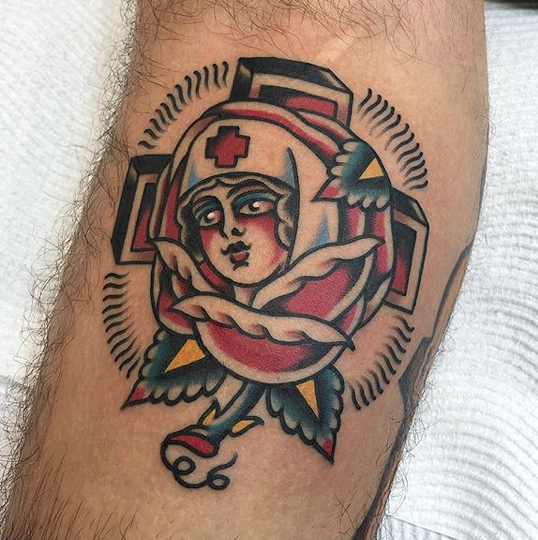
Rose of No Man’s Land by Milky.
Rose of No Man’s Land is an unmistakeable western traditional tattoo reference, classically depicting a traditional ladies head either centred inside or surrounded by red roses. Upon her head, she wears a nurses cap with a Red Cross in the middle, and often there will be another Red Cross in the background.
Although the exact origin of the Rose of No Man’s Land tattoo is unknown, it seems to have popped up sometime in the early 20th century, and is attributed as being an artistic representation of the song, and a way to memorialise the Red Cross Nurses who helped save lives on both the frontline, at military bases and back at home. The Rose of No Man’s Land is a song first published in French (“La Rose sous les Boulets”) in 1918, the year World War One officially ceased. A version in English was recorded and released in 1945, when World War Two was coming to an end.

No Man's Land is the term used by soldiers to describe the ground between the two opposing trenches in times of conflict. The lyrics to the song “Rose of No Man’s Land” are as follows:
There's a rose that grows on No Man's Land
And it's wonderful to see,
Tho’ its sprayed with tears, it will live for years,
In my garden of memory.
It's the one red rose the soldier knows,
It's the work of the Master's hand;
Mid the War's great curse, stands the Red Cross nurse,
She's the rose of No Man's Land.
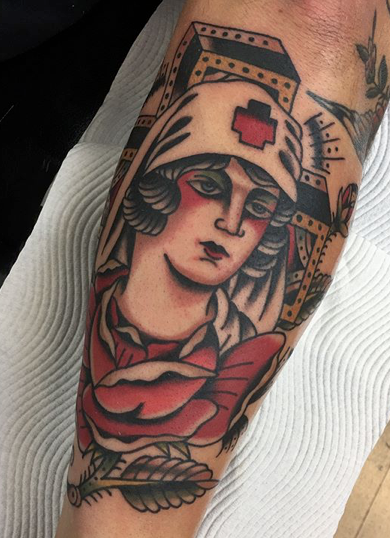
Rose of No Man’s Land by Capilli Tupou.
Imagine being a solider grievously harmed on the battlefield, lying there, terrified that you wont survive your wounds. Miraculously an angelic figure dressed all in white appears and tends to your wounds, helps you back to safety, thus saving your life. These brave women, the Red Cross nurses of World Wars One and Two, were viewed as saviours by the many service men they treated.
The Rose of No Man’s Land tattoo appeared in early sketchbooks of western traditional tattooing greats as Gus Wagner, Norman Collins (aka Sailor Jerry) amongst many others. It quickly became a staple reference within the tattoo industry, which really shows how much of an effect the heroic actions of the Red Cross nurses meant to service men around the western world. Soldiers felt so indebted, so eternally grateful to these nurses, their “Roses”, that in turn they had them immortalised forever on their bodies in the form of a tattoo. A talisman for both their time spent in combat, and for the courageous women who kept them alive to live out their days in peacetime.
Although it’s been over 100 years since The Rose of No Man’s Land first popped up, and many of us are lucky enough to have lived a relatively peaceful life, this classic tattoo is still as popular as ever. The Rose of No Man’s Land may no longer represent a wartime Red Cross nurse exactly, but it is still an undying symbol of respect to our many caregivers around the world. A high stress career, which is often majorly underpaid and under-appreciated by governments and employers.
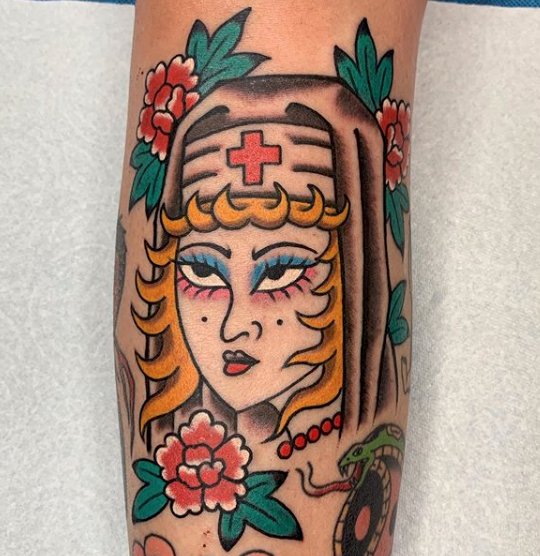
Rose of No Man’s Land by Bernard Kwok.

Rose of No Man’s Land by Lucky Felix.
Despite the fact so many of us are lucky enough that our countries have been in peacetime for much of our lives, the COVID-19 (Coronavirus) pandemic has been compared to dark times in modern history. Only this time the enemy is not being fought in the trenches, there is still a very dangerous front line for healthcare workers and caregivers around the world. Communities have been devastated with over two million people (and rising) diagnosed with the virus, tens of thousands have died, personal freedoms have been taken away as people head into ordered isolation and economies have been hit the hardest we’ve seen in decades. In the United States alone, the number of fatalities has already surpassed those from the Korean War, and conservative estimates predict the number will rise to more fatalities than both the Vietnam War and the 1968 flu pandemic. Higher estimates put it above the fatalities of the 1957/1958 flu pandemic and US soldiers lost in the First World War. Caregivers are literally working on the frontline of this pandemic, making huge sacrifices to help save lives. We’ve seen instances of health care workers separated from their families to ensure it doesn’t get passed on, retired workers (who are generally older and more at risk) come out of retirement to lend a hand, and unfortunately we’ve also seen health care workers perish at the hands of this viral enemy.

The faces of front line workers. Doctors, nurses and caregivers show their battle scars after hours in emergency departments and isolation units treating Covid-19.
The Rose of No Man’s Land tattoo, a nurse nestled in amongst bright red roses, is the definitive symbol of generosity, courage, sacrifice and caregiving. Much like the loved Red Cross Nurses of days gone by, healthcare workers are amongst the most selfless people to exist. The Rose of No Man’s Land in current times still carries the important message of appreciation, adoration and respect for frontline healthcare workers, and hopefully when they see someone with this beautiful image, they feel proud of their sacrifices, supported in their chosen path and less alone in one of the most lonely, dark days of our time.

Rose of No Man’s Land by Capilli Tupou.
Sunset Tattoo is one of Auckland’s leading tattoo studios, and the home to many of Auckland's best tattoo artists. We have artists who specialise in Japanese, Maori, western traditional (examples shown in this article) and black work tattooing. Stunningly beautiful and utterly timeless, western traditional tattoos consist of bold lines, bright colours and classic designs intended to last a lifetime. Fashion fades, style is forever. For enquiries, booking requests and more information about getting tattooed by one of our traditional artists please contact the studio.
CONTACT:
www.sunsettattoo.co.nz
info@sunsettattoo.co.nz